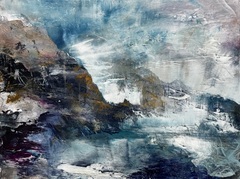
Camille Kouyoumdjian
Artist Statement
My paintings begin with landscape, but I am less interested in describing a specific place than in exploring how place is remembered, altered, and felt over time. Coastal light, fog, rock, water, shifting weather, and geological forms often provide the starting point. I am especially drawn to environments that are continually changing—shorelines, mountains, islands, tidal zones, and other places shaped by erosion, atmosphere, and time.
I work across mixed media, including acrylic, oil and cold wax, collage, ink, and repurposed materials. My surfaces are built gradually through layering, scraping, veiling, sanding, carving, and excavation. I often cover passages that initially seem resolved and then uncover fragments of earlier layers. Marks disappear and re-emerge; edges dissolve; forms shift between clarity and ambiguity. The physical process becomes a way of thinking through the subject rather than simply illustrating it.
This accumulation and removal reflects the way I experience memory. A place is never retained as a complete image. Certain colors, textures, shapes, or sensations remain vivid while others fade, blur, or are reconstructed over time. In the studio, I am interested in allowing that instability to remain visible. Rather than resolving a painting into a single fixed view, I want it to hold traces of multiple moments and multiple ways of seeing.
Collage is central to this process. I use hand-painted papers, fragments of recycled materials, and other altered surfaces to interrupt the painted field and create new relationships between forms. Torn edges, seams, irregularities, and remnants remain visible rather than being disguised. These fragments may suggest rock strata, weather systems, shorelines, vegetation, or distant landforms without describing them literally. They also carry a previous history into the work—something has already existed, been transformed, and become part of a new whole.
Oil and cold wax allow me to approach the surface in a related way. I build translucent and opaque layers, scrape back into them, and expose what lies beneath. I am drawn to surfaces that reveal evidence of their own making. Texture is not decorative for me; it records the history of decisions, revisions, concealments, accidents, and discoveries that produced the painting. The marks left by scraping, sanding, cutting, or pressing into the surface become as important as the painted image itself.
I also use unconventional mark-making tools and materials to keep the process open and unpredictable. Found objects, repurposed tools, torn paper, and improvised implements allow me to make marks that are less controlled than those produced by a traditional brush. I value the tension between intention and accident. Often the most interesting passages emerge when I respond to something unplanned—a scraped edge, a partially obscured form, an unexpected color relationship, or a fragment that changes the direction of the composition.
The natural world remains central to my practice. Years spent observing protected landscapes and coastal environments have made me attentive to their fragility, complexity, and impermanence. Conservation is an important underlying presence in the work, but I do not approach it as an illustrative or didactic subject. Instead, it enters through an awareness of change, loss, resilience, adaptation, and interconnected systems. A shoreline altered by weather, stone exposed by erosion, or land briefly obscured by fog can become both a visual experience and a reminder that landscapes are never static.
My paintings move deliberately between abstraction and recognizable landscape. I am interested in the point at which a form can suggest mountain, water, rock, forest, or horizon without becoming a literal description. That ambiguity allows the viewer to enter the painting through personal memory and association rather than being directed toward one specific place or narrative.
Light is often one of the organizing forces in the work. I am drawn to moments when illumination changes how a landscape is perceived—when fog softens an edge, water reflects an unexpected color, or a bright passage briefly reveals a form before it disappears again. These transitions between visibility and obscurity parallel the process of memory itself: some things remain clear while others are altered by time.
I think of each painting as an evolving surface rather than a depiction of a fixed scene. The visible image is only the most recent layer of a longer history. What has been covered, removed, scraped away, or partially revealed remains present, even when it can no longer be clearly seen.
Ultimately, my work is about thresholds: between land and water, permanence and transformation, visibility and obscurity, observation and memory. I want the paintings to feel grounded in the physical world while remaining open enough to hold uncertainty, change, and individual interpretation.
Portfolio
The Breathing Shore
oil and cold wax • 2025
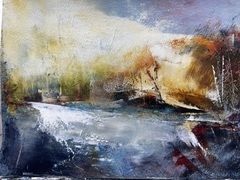
Autumn Rising
oil and cold wax • 2025
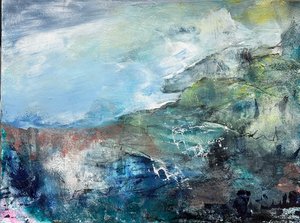
Above The Clouds
oil and cold wax • 2026