Maia Sciupac
Artist Statement
What happens when you outgrow the shape you were given? My work begins there. Through mixed media portrait collage, I explore the moment when expectations no longer hold, when the life you built doesn’t fit anymore, and change becomes unavoidable. That shift is uncomfortable, necessary, and revealing. It exposes power in its most personal form: the pressure to remain who you have been and the choice to break from it in order to become more self defined.
As the first born child and daughter of Latin American immigrants, I think about how identity is shaped early by family, language, race, ethnicity, gender, and sexuality, often through expectations left unspoken. That experience informs my work, but it does not define it. I am interested in how identity forms under pressure and how it shifts when that pressure no longer applies. My thinking is informed by Kimberlé Crenshaw’s articulation of intersectionality, which names how overlapping identities shape our relationship to power, as well as by bell hooks and Gloria Anzaldúa, who write about identity across tension, contradiction, and in between spaces. We are not one fixed self. We move through the world carrying multiple identities, and those identities are read and valued differently depending on the context. A person can have power in one space and lose it in another.
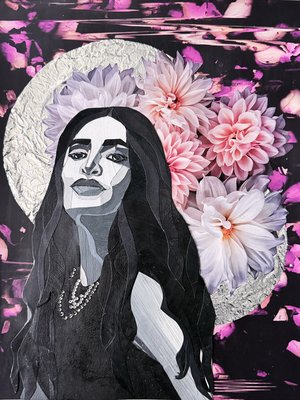
I explore these ideas through collage portraiture, where fragments, surfaces, and materials build meaning together. I use paint, archival imagery, scanography, and reflective surfaces to address memory, protection, resilience, and visibility. Glitched scans of wildflowers and personal memorabilia suggest change that persists through disruption. Reflective materials, including emergency blankets and rhinestones, create tension between shielding and revealing the self while introducing optimism and beauty. In many works, figures move between black and white and color, marking the distance between who a person has been, how they are perceived, and who they are becoming. Color also draws attention to meaningful expressions and postures, such as the loving embrace and protective eye of a mother with her newborn child. Portraiture allows me to make contradiction visible without reducing a person to a single narrative.
If identity is constantly negotiated through shifting power and expectation, then the question becomes: who do we choose to be and how do we become that person? For me, that process is not linear. It can feel like trying on different versions of the self, keeping some and letting others fall away. Over time, there is clarity and a growing sense of assurance, but the process remains vulnerable and unsteady. More recently, I have turned this lens toward myself through self portrait collage, working through the period after my marriage ended. That work asks who I am when familiar roles fall away and what it means to move toward a version of myself that feels more aligned.
Alongside this, I create portrait collages of other Latinas/es shaped by defining moments of transition: divorce, loss, motherhood, migration, or personal reinvention. I am interested in what is given up in those moments and what takes its place. These works center women whose identities are too easily reduced or generalized, giving attention to their specificity, complexity, and evolution. This focus is personal. It comes from my own history and from a desire to reflect the range of experiences within Latina/e identity without flattening them into one story.
Material is central to how I build meaning. I work on cardboard because it is temporary and able to carry weight without pretending to be fixed. It mirrors the instability of identity during transition. Collage is essential to my process because identity is also assembled. Fragments coexist. Layers reveal and conceal. Materials carry memory. This allows me to work with contradiction without resolving it. My portraits show individuals in a state of becoming. They are not fixed or complete. They carry evidence of what has been lived through and what is still unfolding.
The work insists on complexity and resists reduction. It asks what it means to live across multiple realities at once, and how a person defines themselves within and against the forces that shape them.
Portfolio
Not All of it Was Mine. This is What Came After
Acrylic paint, watercolor paper, printed images, metallic blanket, rhinestones.
$800
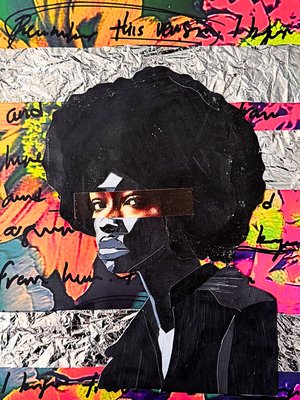
I Begin from Here
Acrylic paint, watercolor paper, printed photography, metallic blanket, acrylic marker.
$800