Ben Wagner
Artist Statement
The end of the world is never the last thing that happens.
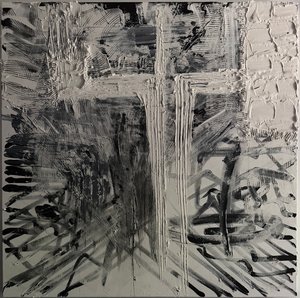
These four paintings take their names from four traditions that each imagined the end of the world, and each refused to stop there. Surtr is the fire giant of Norse myth who burns the world at Ragnarök. When the fire is spent, the earth rises green out of the sea and two survivors walk out of the wood to begin again. Pralaya is the Hindu dissolution, the universe returned to water between one age and the next, held there until it is made again. Dur-An-Ki, the Sumerian bond of heaven and earth, names the tie between sky and ground, which were once a single body until they were pried apart so the world would have room to exist. Minokawa is the dragon-bird of Philippine folklore that swallows the sun and the moon. People beat pots and shout until it gives the light back.
None of these traditions treated destruction as the last word. They treated it as the thing that clears ground. The paintings look like devastation at first. Structurally, they are about what follows.
All four come from one series, and the series moves. The first three are axial and centered: a sword, a vessel, a falling column, the viewer standing inside the event. Minokawa breaks the axis. It is the only one with something alive in it, and it lifts you out of the event entirely, above the world, removed, watching something that has no interest in you. Hung in this order, the series runs from rigid symmetry to release.
The work is black and white acrylic and spackle on canvas. I build the surface up, rake it, cut into it, bury it and expose it again until it behaves like evidence rather than image. Each painting holds a record of force: material against hand, decision against correction, collapse against repair.
The material performs the theme, and I have learned to trust it over my plans. Spackle goes on dark and wet and dries to white. Thin passages veil what sits beneath them; thick ones bury it. For two weeks while a painting cures, I dust it with a wide brush, and the weakest material falls away on its own, so the surface edits itself. Then the varnish goes on, and something returns. Blacks that read as dull gray for weeks come back at full depth. Rings appear where there were only smudges. The raked troughs open up. Nothing new is added. What was already there becomes visible. Every one of these paintings spent a stretch looking finished and wrong, and then became itself.
That is the version of renewal I believe in. Not a clean slate, but a surface that keeps its history and lets you see it. When new material skips across old relief and lodges there, it does not cover what came before. It reports on it.
My eye was formed between two places, the discipline of Kyoto and the pressure of Berlin, where restraint and rupture coexist without resolution. I am drawn to what does not conceal itself: objects and bodies that carry time visibly, without apology or translation.
The relief is deep enough that the paintings change with the hour, the light and the distance. From across a room each reads as a single event. Up close it breaks into thousands of small decisions. The person who lives with one of my paintings tells me it means something different every morning, and I take that as the point. I do not explain the work. I want it to hold its ground immediately, and keep unfolding in memory after you walk away.
Each of these is an ending that kept going.
Portfolio
Surtr
Acrylic and spackle on canvas · 2026
$1600
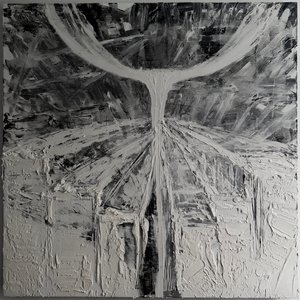
Pralaya
Acrylic and spackle on canvas · 2026
$1600
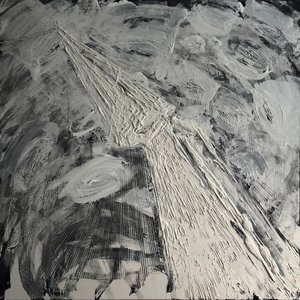
Dur-An-Ki
Acrylic and spackle on canvas · 2026
$1600
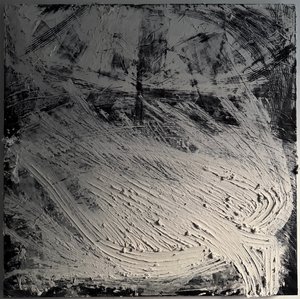
Minokawa
Acrylic and spackle on canvas · 2026
$1600