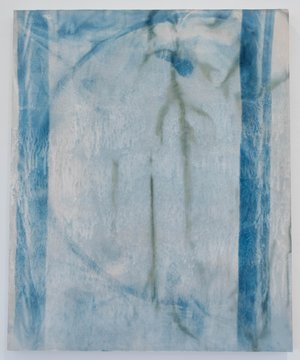
Madison Jones
Artist Statement
My work explores transformation, memory, and ecological change through process-based printmaking. I draw inspiration from the ghost forests along the Pacific Northwest coast, particularly the Neskowin Ghost Forest in Oregon and the Copalis Ghost Forest in Washington. These forests were formed in 1700 when a massive earthquake along the Cascadia subduction zone triggered a tsunami that submerged coastal woodlands in saltwater. The trees died where they stood, their roots suddenly inundated by an environment that could no longer sustain them. Centuries later, the remains of these trees still emerge from the shoreline as darkened trunks and weathered stumps. What once was a living forest has become something else entirely: a skeletal landscape shaped by time, tide, and erosion.
Ghost forests embody a tension between absence and persistence. They function as remnants of ecosystems that once flourished, but they are not simply ruins. The decaying wood has become a host for new forms of life, such as barnacles that cling to the surfaces of the trunks and stumps. These remains, once part of an earthly environment, now belong to the ocean. In this way, the ghost forest exists between states: between land and ocean, life and death, memory and transformation. This layered condition forms the conceptual foundation of my work.
I am drawn to environments where something that once existed has disappeared or been altered beyond recognition. Dead landscapes, hollowed trees, and submerged structures carry traces of what came before while simultaneously accommodating new forms of growth. These sites reveal the cyclical nature of environmental change and the persistence of material memory. In my work, the ghost forest becomes both a visual reference and a metaphor.
My practice centers on printmaking processes that echo these transformations. Cyanotype printing and intaglio etching are central to my work because both involve chemical reactions that alter surfaces over time. Cyanotype, a nineteenth-century photographic process, produces deep blue images through exposure to ultraviolet light. The process records an impression of objects placed on the surface, capturing their outlines in luminous shades of cyan and indigo. Historically used for scientific documentation and botanical studies, the cyanotype preserves delicate forms while also transforming them into something atmospheric and abstract. In my work, these impressions function less as direct representations and more as traces; visual residues of forms that once occupied the surface.
Etching offers a parallel process of transformation through erosion. Instead of using light to generate an image, etching relies on acid to corrode a metal plate. Ferric chloride slowly bites into the surface of copper, carving lines that will later hold ink during printing. I am drawn to the paradox at the center of this process: to produce an image, the plate itself must be degraded. This act of corrosion mirrors the environmental processes that shape the ghost forests. Just as saltwater infiltrates living trees and gradually reshapes them, acid slowly transforms the metal plate into an image-bearing surface. In both cases, destruction becomes a generative force.
Through these processes, my work moves between representation and abstraction. Many images originate from photographs of natural forms such as branches, roots, or geological structures, but the processes of cropping, enlargement, layering, and chemical alteration gradually obscure their sources. The resulting images resist immediate identification. Viewers may sense something familiar within the compositions, yet the forms remain ambiguous. This ambiguity invites a slower kind of looking that prioritizes atmosphere, texture, and material presence over direct representation.
Ultimately, my work considers how material processes can mirror the transformations of the natural world. The ghost forest becomes a framework for thinking about time, erosion, and regeneration. By allowing light, chemistry, and chance to shape the image, the work embraces the instability inherent in both natural systems and artistic processes. Each print becomes a record of change: an impression formed through exposure, alteration, and gradual transformation.
Like the ghost forests themselves, these works exist between states. They hold traces of what once was while continually shifting into something new.
Portfolio
Distilling
Cyanotype on fabric mounted panel • 2023
$1100
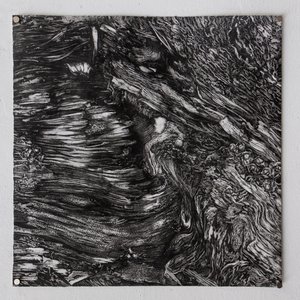
Cascadia
Etching and aquatint with sugarlift and mezzotint on Hahnemuhle • 2024
$850
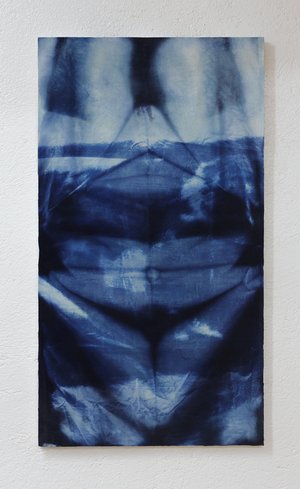
Banding
Cyanotype on fabric mounted panel • 2025
$700