Brooke Lanier
Artist Statement
Once things start to fall apart, you can see how they were constructed and what they’re
made of. I have a great affection for ships and buildings that show the marks of age and the
physical evidence of their history. Over time, they develop great character, like scars and
callouses and the lines on the faces of old friends.
What we choose to commemorate is a value judgement. In my art, I focus on the things I
find most moving, fascinating, or delightful as a way of understanding them better and
sharing them with other people. Many of my paintings are love letters to obsolete relics of a
maritime past. The elements are at odds with the once-pristine forms and surfaces of
these feats of engineering. These ships were built to traverse the very water that constantly
threatens their structural integrity. Eventually, nature wins. The flooded basement of a
building in the Philadelphia Navy Yard is home to a flourishing school of goldfish, and the
SS United States will become a habitat for marine life soon.
The paint protecting a ship is inevitably permeated during voyages and working life,
resulting in corrosion. The more the water takes effect, the more you can discern the ship’s
construction and materials. Water seeks the lowest point, flowing around rivets and
fasteners, peeling up the paint in layers, revealing the bright yellow primer, the rusted steel,
the gray of oxidized aluminum, the bead of a weld.
I’ve been fortunate to discover that maritime history enthusiasts and shipwrights are eager
to share their expertise on these processes. My art has helped me connect with the
communities surrounding the SS United States Conservancy and the tall ship Gazela, both
of which figure prominently in my work of the past 5 years.
Many of my recent paintings depict aspects of the SS United States, a combination luxury
ocean liner and Cold War rapid troop transit ship built in 1952. Her revolutionary design
utilized aluminum instead of steel for her superstructure, dramatically decreasing the
weight of the ship. She still holds the record for fastest transatlantic crossing by a
passenger ship. In homages to the hull of the SS United States, I use iron oxide to depict
the rusted corroded steel, and I build up and scrape away layers of paint or clay in a
process that echoes the weathering of the ship itself. Her design combines mid-century
elegance and architectural problem-solving to create a geometry that frames the sky and
water so beautifully.
I was initially drawn to the complex textures and imposing form of the bow of the SS United
States, since that’s what I could see the best at a distance through a fence in South
Philadelphia. My solo show at Novado Gallery in 2023 featured paintings of this ship, which
got the attention of Susan Gibbs, president of the SS United States Conservancy and
granddaughter of the ship’s architect, William Francis Gibbs. She liked my paintings and
invited me to tour the ship. At the time, the SS United States was berthed in an active port,
and I had to get Homeland Security clearance to tour. Few people had this opportunity,
because the ship is a giant insurance liability full of missing railings and tripping hazards.
Over the last year she was in Philadelphia, I had the privilege of touring the ship three times
to document her before she was towed to Mobile, AL, where she’s being remediated in
preparation to be sunk as an artificial reef off the coast of Okaloosa County, FL. Since I can
only make so many paintings in a year, I decided to focus on underappreciated views of the
SS United States, like promenades, stairwells, and interiors.
These tactile ceramic sculptures are companion pieces for my paintings, and a different
way of understanding space. Everyone not-so-secretly wants to touch the impasto
surfaces of my oil paintings, and these sculptures are specifically intended to be touched.
Constructing them helped me understand these ships more fully, since I realized how
much I focused on little details of the ships’ exteriors but lacked an understanding of how
the parts make a whole. You never think so much about how something is constructed until
you try to build it yourself.
I’ve had vision problems my whole life and am blind in my right eye. In 2023 I developed
obstructive floaters and increased light sensitivity in my good eye, and I decided it was time
to learn ceramics. At my core I am an artist, and in the worst-case scenario, if I have an
accident and go completely blind, I will still be able to make things with my hands. These
tactile sculptures also make my art accessible for blind people.
My ceramic sculptures offer physical approximations of differences in ship construction
techniques: Overlapping strakes of metal riveted together vs. merged in a raised weld are
represented by layered slabs of clay with piped-on slip in raised bumps of “rivets” vs areas
of wetter clay manipulation.
Portfolio
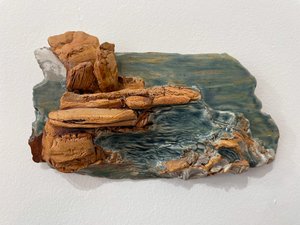
Ceramic Tide Pool Wall Sculpture
Mid-fire stoneware with glazes and oxides, aluminum cleat hardware • 2025
$400
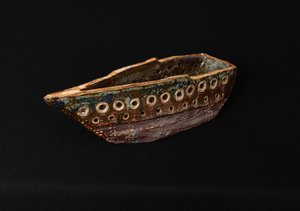
rudderless cruiser with fantastic views
Mid-fire stoneware with glazes, slip trailing, sgraffito, and oxides, • 2023
$500
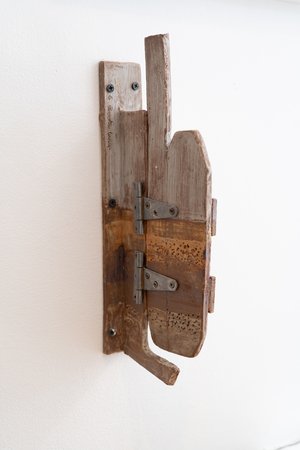
Functional Rudder for Round Trips
ceramic, wood, metal hardware, slip, oxides • 2024
$500