Gustave Carlson
Artist Statement
Gustave Carlson's body of work is a profound exploration of the portrait, with a particular emphasis on barns, agrarian vernacular, and forgotten houses. In his paintings, Carlson creates a sense of place that feels both familiar and unknown. His acute awareness of building shapes and perspectives, coupled with his commitment to landscape stewardship, positions his work as a form of documentation.
Carlson attempts to develop his work as an intersection of studying American painters Fairfield Porter, Richard Diebenkorn, Wayne Thiebaud, and Edward Hopper. Carlson’s consistent hand of bold color field painting can be traced to his studies with Adele Alsop at The Graduate School of Fine Arts at University of Pennsylvania.
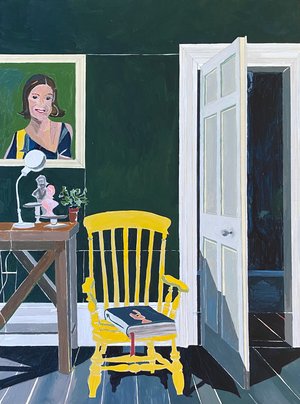
Carlson's perception of the landscape as a blanket or wallpaper that envelops the surface is vividly translated into his art. His paintings evoke themes of decay, architectural typology, nostalgia, light and shadow, and patterns of haunted time. Notably, the chairs in his paintings serve as metaphoric representations of the human figure. Carlson's technique is marked by a juxtaposition of thick, layered applications and thin, underdeveloped areas or “spaces between”.
Engaging in the simultaneous creation of multiple paintings, Carlson allows for the emergence and overlay of earlier forms, resulting in a palimpsest-like effect known as pentimento. This nuanced interplay between presence and absence is a cornerstone of his artistic comfort zone.
Portfolio
Belden's Parlor
acrylic and graphite on wood panel framed • 2025
$1500.00
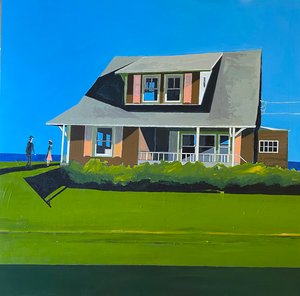
Almost a Conversation
acrylic and graphite on wood panel • 2025
$2500.00
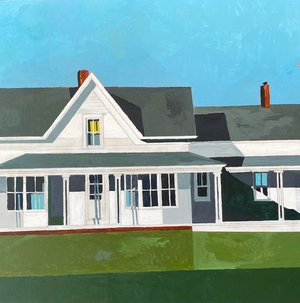
Carpenter Gothic
acrylic and graphite on wood panel • 2025
$1000.00