Patrick Cosgrove
Artist Statement
My paintings begin with places that feel familiar, enduring, and alive with atmosphere. I’m drawn to scenes where the natural world and human presence coexist in harmony, because those are the places that often feel most deeply lived-in. Each work offers not just a view, but a pause, a place where memory, beauty, and presence meet.
Like the early 20th Century California Impressionists, I'm attuned to light over the landscape, to edges of fields catching early and late sun, river surfaces at dusk, sky drama over flat farmland, surf drama at the coast. My compositions often use a strong horizon and deep atmospheric space, including fields and rivers leading us back into distance. I'm frequently trying to balance serenity and structure: quiet subjects, but with deliberate geometry from roads, tracks, levees, docks, farm buildings, and orchards. It’s a specific, modern West and Central Valley infrastructure where the sky and atmosphere dominate the psychological feel of the image, akin to someone capturing Northern California with one eye aimed toward weather and human imprint. I aim for a quiet documentary undercurrent, a sense of place, the politics of land use, agriculture, and the built environment, even when the image stays lyrical.
My paintings are rooted in photographic seeing. There is a regionalism, an attentiveness to intertwined human and natural structures whether they're found in the mountains, the agricultural Valley, or the coast, born of my personal history of crisscrossing Northern California in all its bountiful topography countless times. I maintain a quiet, observational distance, rendered with what could be called "western chroma," those saturated sunsets, turquoise and cobalt water, deep skies, and harvest-ready and fallow-field contrasts.
I aim to create a feeling of being within a lived, revisited place, of embedded time. The combination of my filmmaker's sense of sequence (roads, tracks, implied journeys) and a painter's sensitivity to light create a distinct, hybrid voice. My work grows out of the traditions of Post‑Impressionism, California Impressionism, and American Regionalism, but it lives firmly in the contemporary West. I’m drawn to the same questions of light, form, and atmosphere that animated Cézanne and the early California landscape painters as I organize fields, rivers, and skies into clear planes of color and shifting weather. At the same time, my subjects place me in conversation with American Regionalists and social landscape photographers who look closely at working land and everyday infrastructure. Having spent decades working with photography and film, I enlist the camera’s way of framing the world. Sometimes the photo is enough; at other times I use my photographic references for brush and palette knife to slow time down, deepen color, and invite a more contemplative encounter with these ordinary but charged places.
I lean into a Nature where the human presence is part of the spiritual landscape, not separate. I hope to render the moment where our ordinary, too busy life sits inside something quieter, more vast. In effect, the sacred doesn’t start where the fences and power lines end; it’s all one field.
Portfolio
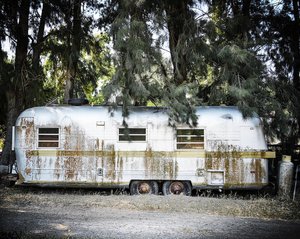
TheRoad'sEnd
InkJet Print
$425
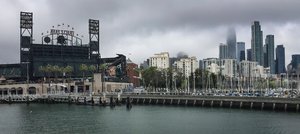
An Oracle
InkJet Print
$450
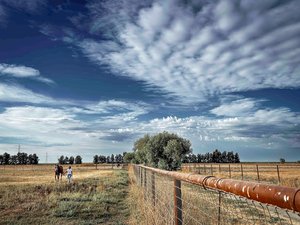
The Turnout
InkJet Print
$425