Deborah Kennedy
Artist Statement
Deborah Kennedy
Artist Statement
My artwork is conceptually-based and guided by an inquiry into environmental themes. It includes book art, drawings, and installations exhibited in galleries and museums. My recent project is an illustrated book, Nature Speaks: Art and Poetry for the Earth, a recipient of six book award including a Silver Nautilus and the 2017 Poetry Award from the Eric Hoffer Book Awards.
My creative process begins with essential questions. These questions lead to periods of research that inform my choice of images, materials, and methods for the final artwork. My initial questions might be: What new ways of thinking can help us solve our environmental problems? How can art reveal the connectivity of the web of life? My subsequent research leads me to investigate the mass extinction of animals and the power of regenerative forces. These three elements a concern with environmental themes, a research-based creative process, and an emphasis on both concept and form--define and unify my work. My art invites contemplation, dialogue, and action.
Entry 1. Stiff Wind: Mesocyclone and the White House, 2017, Painting: Mixed media on panel, 36’ x 24” x 2”
This painting is part of a series pairing severe weather events and American national monuments. Severe weather events are increasing in number and severity due to the burgeoning climate catastrophe emerging across our country and globe. Mesocyclones are severe weather events characterized by a rapidly rotating air mass and are associated with severe thunderstorms and multiple tornados.This juxtaposition of the White House and a massive mesocyclone suggest that destructive weather and negligent political forces can both threaten our country.
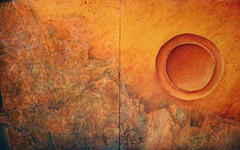
Entry 2. Without a Care, 2019, Painting: Mixed media on panel, pages from a physics textbook, 24” x 48” x 2”
For this artwork, I gathered torn pages of a physics textbook left strewn on a sidewalk. The pages illustrate the basic principles governing the physical world, principles that underlie all our science and technology. As we see today, these principals can be used to benefit and to harm human health. A human egg floats above this landscape. As the rates of serious birth defects and miscarriages rise around the world, when will science and technology be used to protect our genetic heritage?
Entry 3. allconnected, Painting, Mixed media on wood panel, 24” x 72” x 2”
This painting explores the impact of chemicals on amphibian and human health. The images include: large spheres representing frog eggs at early stages of development; a ball and stick model of the chemical structure of Atrazine, our most popular herbicide. We use about 70 million pounds of Atrazine annually in the USA. It is commonly found in drinking and surface water. Current research shows that Atrazine impairs thyroid function in frogs. At the top of the composition is a model of thyroxine—a ubiquitous hormone essential for all life functions shared by humans and frogs. This painting illustrates the connections between often ignored, yet critically important keys to life.
Entry 4. Changed Climate, 2017, Sculpture, Drywall screws, recycled nature and ecology books
This installation invites viewers to contemplate our current ecological crises. The books in this artwork, now rendered inaccessible, contain images of a thriving natural world, now either gone or damaged, and important scientific information concerning our declining environment. Ecological challenges explored in these books include rising rates of species extinctions, ocean acidification, the death of coral reefs, forest mortality, pollution of our air and water, as well as an increasingly unstable climate. Climate change, our most pressing problem, is accelerating many of these environmental challenges, and may soon threaten the stability of our societies as food and water become more expensive and scarce.To protect our planet and ensure a healthy future for ourselves, our children, and the natural world, we must be guided by good science and the life-sustaining principles of nature.
The worldwide response to global warming has been slow and halting. However, in 2015 195 countries signed on to The Paris Agreement. This is the first international legally binding agreement of its kind, committing these nations to reducing their greenhouse gas emissions. The United States of America’s leadership role in this important work is now severely diminished.
Entry 5. Memorial Field Guides for the 21st Century, 2016, Sculpture, Recycled books, grass, feathers, anatomically correct model of a threatened Yellow-Legged Frog, recycled metal, air-dry clay, medium and pigments
Traditionally, nature guides introduce readers to the complexity of healthy ecosystems. Kennedy's altered books, though inspired by these nature guides, instead invite reflection on today's environmental challenges.
Memorial Field Guide for the Birds
The quietude Rachel Carson foresaw in her seminal book, Silent Spring, is spreading through our world as birds disappear. Today, bird populations are declining around the planet and one avian species is going extinct each year. Who still feels the loss of their songs?
Memorial Field Guide for Amphibians
Amphibians including frogs, toads, newts and salamanders were the first class of animals to experience a global population collapse. Today, the situation is even more dire—more than a third of amphibians are threatened globally by habitat destruction, toxics, pesticides and global warming among other problems. Is a world where frogs cannot survive a world where our children can survive?
Memorial Field Guide to the Human Heart
People today are living in a collapsing world, yet most seem to largely ignore this heart-breaking situtation. We march on despite the obvious threats around us. If not now, when will we make reviving our natural world a serious priority? Will we wait until disaster is at each of our doors?
Portfolio
Human Egg: Without a Care
Mixed media on wood panels • 2018
Not for sa
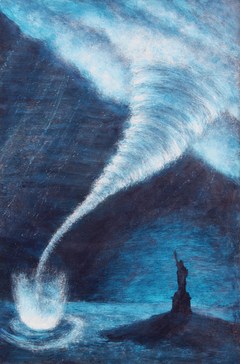
Hard Rain: Waterspout and the Statue of Liberty
Mixed media on wood • 2015
$2500.00
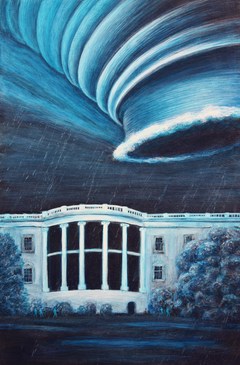
Stiff Wind: Mesocyclone and the White House
Mixed media on wood • 2015
2, 500.00
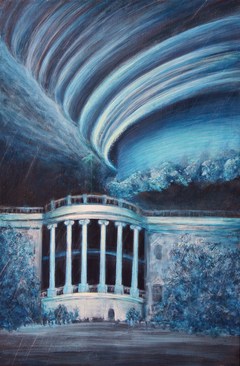
Untitled