suzanne sillery
Artist Statement
Artist Statement
My art has been a process, which has evolved in the last couple of years to express my feelings about death and how it has affected my insight on life. Death has been a major influence in my life. Being brought up by a forensic pathologist has caused me to analyze life differently. The images of cells I paint are taken from slides of terminally ill patients or ones who have passed away. The purpose of my art is to develop representations of images that depict death in a positive light.
I was brought up in lab and still work in a lab. I have worked with different mediums, but painting has provided me the most effective way to interpret my art. I take pictures of the cells through a microscope and then crop them in the computer to be used for my paintings. How I interpret these images changes during the development of the painting. They have a life of their own with paint on canvas. I sometimes take the positive and negative space, making the negative positive and vice versa, as the vacant space of cells on a slide can dictate a different diagnosis. When looking at the cells, they affect me with different sensations; my brush strokes interpret those feelings. Cells that dominate the slide require me to maintain a continuous brush stroke, with enough paint on the brush to follow through with one motion, while applying different pressure at the same time on the canvas. When there is an abruptness of the cells, there is abruptness of the stroke. The paint applied thickly, not completely mixed, and represents unhealthy cells that are mutating into healthy cells. The rhythm and flow of the cells on the slides help in the development of the composition. The mood is set by color with different intensities that will convey a certain feelings. The strokes of paint moving in certain directions or with continuous flow will help to create the image to look either subdued or intense. My pace may change from working fast to slow; the rhythm and timing depend on how I am interpreting these images at that time. Sometimes there is continuous movement by me throughout the work, as to represent death as passing on into its natural stage in life (the spirit.) The procedure has gone further. I have started to remove paint from the image with a surgical blade and placing it on different parts of the painting. The same process is done in a lab when specimens are cut into more deeply from the tissue block for further investigation. Also, I am carrying the process in a additional way with my recent painting, by creating paintings that are finished, but also have a painting underneath, which I then go back into when somewhat dry and peel the top painting partially off to reveal the information underneath. I am also going to take it a step further and remove part of the painting when somewhat dry with grossing knives, which are used in the lab to cut specimens, and place that on a different canvas to represent that part of the tissue that is placed on another slide. Since composition size, structure, and color of cells all have meaning on a slide through the microscope, the process to obtain knowledge with the information presented will help in the conclusion of someone’s death. This is the same premise I apply to my art. Each new painting challenges me to investigate my senses; how I hear, see, touch, feel, and think helps in the interpretation of the information that sets the course that my art follows.
The purpose of my art is to go through the process in pursuit of a final composition (diagnosis,) and give significance to that person’s life. My paintings are their portraits, a person’s signature of their life, the epitaph of their physical matter that is reduced to a few cells on a slide for a final diagnosis of their death, and cataloged for history. I celebrate their sprit being set free, so their memories stay alive in our minds.
Suzanne Sillery
Portfolio
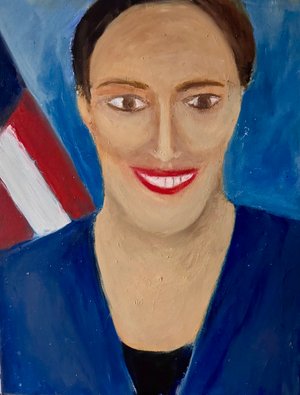
He would've won
Oil on canvas • 2026
$1000
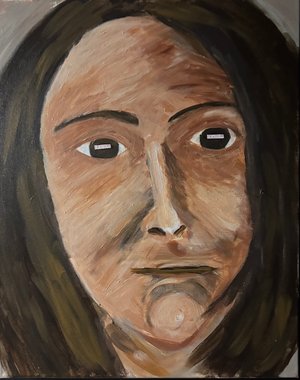
Shame
Acrylic on canvas • 2026
$1000
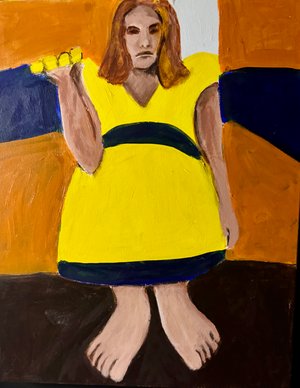
JD Vance
Acrylic on canvas • 2026
$1000